5 Custom Kitchen Cabinets to End Cabinet Chaos
Custom kitchen cabinets solve cabinet chaos by replacing deep, awkward storage with purpose-built drawers, dividers, pull-outs, and compartments. For Charles County, MD homeowners, the right layout can keep containers, lids, cookware, and everyday essentials visible, reachable, and matched—although science may never explain where that one missing lid went.
Why does cabinet chaos happen?
Most kitchen storage problems are not caused by owning too many things. They happen because standard cabinets are designed around construction efficiency—not the way your household actually cooks, shops, stores leftovers, or reaches for a roasting pan.
A typical cabinet may have:
- A deep shelf where small items disappear
- One large drawer trying to store six categories
- Tall, wasted space above short containers
- Doors that hide clutter instead of organizing it
- Corners that become architectural black holes
The result is familiar: you open a cabinet carefully, as if defusing a bomb, and a stack of plastic containers makes a break for freedom.
Custom storage begins with an inventory of what you own and how you use your kitchen. That means designing around your containers, appliances, cookware, ingredients, and routines—not forcing your life into a generic box.
What are the best custom kitchen cabinets for containers and lids?
The best solution is usually a combination of cabinet organizers rather than one magical compartment. A kitchen designer can create zones that give each category a logical home.
1. Wide rollout drawers
Rollout drawers bring the back of a cabinet to you. Instead of kneeling on the floor and excavating three saucepans to find a lid, you can pull the entire shelf forward and see everything at once.
They work especially well for:
- Food storage containers
- Pots and pans
- Small appliances
- Mixing bowls
- Pantry staples
For heavy cookware, specify sturdy hardware with a suitable weight rating. Smooth movement is wonderful; a drawer that surrenders under the weight of your Dutch oven is less wonderful.
2. Adjustable lid dividers
Lids need vertical storage. When they lie flat in a stack, the smallest lid often migrates to the bottom, creating a daily archaeological dig.
Adjustable dividers let you store lids upright by size. They can be installed in a drawer, inside a cabinet, or near the refrigerator for quick access. Choose removable or repositionable dividers so the system can evolve when your collection inevitably does.
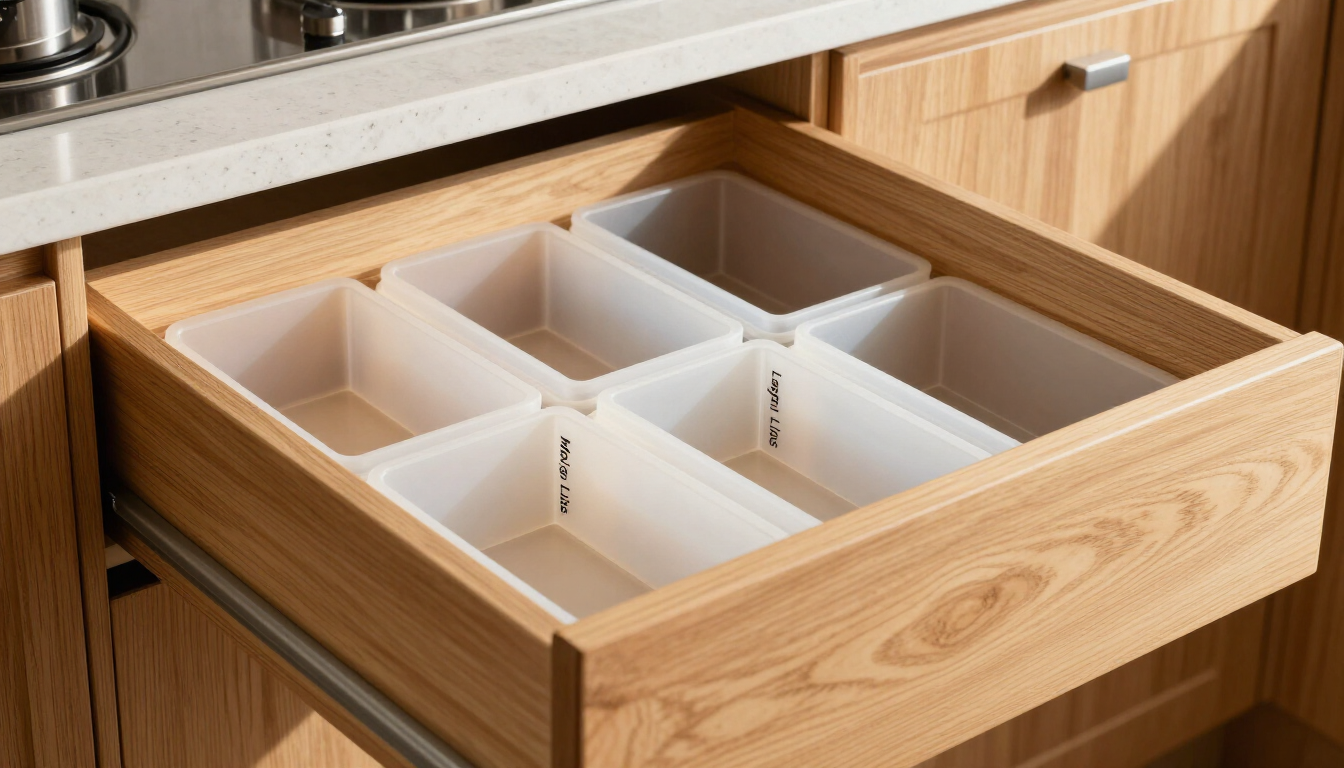
3. Deep drawers for containers
Food containers are easier to manage when separated from their lids. Use one drawer for bases and another narrow section for lids, or create a divided drawer with dedicated slots.
A practical setup includes:
- Nesting containers by shape and size
- Storing lids vertically beside them
- Keeping frequently used pieces at waist height
- Leaving enough clearance to remove items without unpacking the drawer
The goal is not an Instagram-perfect display. The goal is to close the drawer on the first try.
Which cabinet organizers make the biggest difference?
Not every organizer belongs in every kitchen. The best choices depend on cabinet dimensions, budget, and your habits. During a Remodeling Consultation & Design , the layout can be reviewed before construction begins.
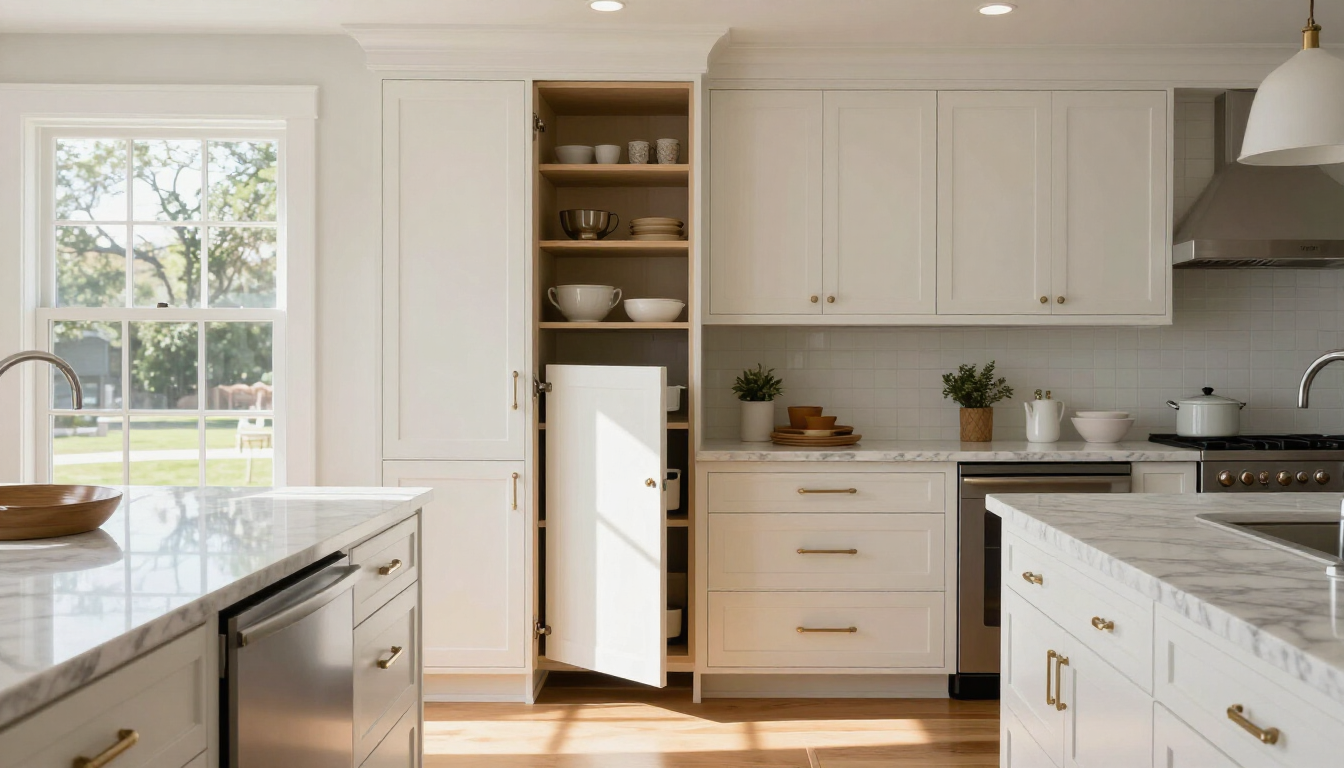
Pull-out pantry shelves
Tall pantry cabinets offer excellent capacity but can hide ingredients in the back. Pull-out shelves make canned goods, baking supplies, and snacks easier to view and rotate.
A pull-out pantry is particularly useful for households that buy in bulk. It reduces duplicate purchases because you can see what you already have—possibly preventing the acquisition of your ninth jar of paprika.
Corner storage systems
Corners are notorious for swallowing useful square footage. A corner pull-out, lazy Susan, or specialized drawer system can turn that space into accessible storage.
The best option depends on the cabinet shape and what you need to store. Lazy Susans are useful for bottles and smaller items. Pull-outs can provide better visibility for cookware or appliances.
Tray dividers
Vertical tray dividers create dedicated slots for baking sheets, cutting boards, serving trays, and cooling racks. They prevent flat items from leaning against one another in a chaotic pile.
Place tray storage near the oven or food-preparation area when possible. Good organization reduces unnecessary steps, and fewer steps mean fewer opportunities to drop a cutting board on your foot.
Appliance garages and lift-up doors
If your countertop is crowded with a toaster, blender, coffee maker, or mixer, custom cabinetry can hide appliances while keeping them accessible. An appliance garage or lift-up door can preserve a clean visual line without requiring you to haul heavy equipment from a basement shelf.
Ventilation and electrical access should be considered during design. Storage should be convenient, not a tiny cabinet-based escape room.
How should a kitchen storage layout be planned?
Start with zones. A well-planned kitchen places related items near the location where they are used.
Prep zone
Store cutting boards, knives, mixing bowls, measuring tools, and frequently used ingredients near the primary preparation area. Deep drawers and tray dividers are especially helpful here.
Cooking zone
Keep pots, pans, lids, utensils, oils, and spices near the cooktop or range. A drawer beneath the cooktop can be ideal for cookware, while a narrow pull-out can hold oils and seasonings.
Cleanup zone
Place dish towels, cleaning supplies, trash and recycling accessories, and everyday dishware near the sink or dishwasher. A drawer for towels prevents them from becoming a decorative pile on the oven handle.
Storage zone
Use pantry pull-outs, tall cabinets, and organized drawers for bulk goods, food containers, serving pieces, and less frequently used equipment.
This zoning approach is one reason a full kitchen remodel can solve problems that a simple cabinet replacement cannot. The goal is to improve the entire workflow, not just install attractive doors.
What should Charles County homeowners ask before choosing cabinet storage?
Before selecting custom cabinets, ask practical questions about the project and your daily routines:
- How much usable storage will the design add?
- Which items should be stored at waist height?
- Can shelves and dividers be adjusted later?
- What hardware is appropriate for heavy drawers?
- Where will small appliances, lids, and trays live?
- How will the layout improve movement between the refrigerator, sink, and range?
Bring photographs of your current cabinets to a design appointment. A short video of the container avalanche is also acceptable, provided nobody is injured during filming.
Reviewing completed work in a Project Portfolio or Kitchen Gallery can help you compare cabinet styles, drawer configurations, and storage details. You can also read Testimonials to understand how local homeowners experienced the design and remodeling process.
Custom cabinetry versus store-bought organizers
Store-bought organizers are useful for testing an idea or improving an existing cabinet on a modest budget. They are affordable, removable, and often available immediately.
However, they may leave unused space around the edges, fail to support heavy items, or fit poorly in irregular cabinets. Custom cabinetry is designed to use the available width, depth, and height more efficiently.
Choose store-bought organizers when:
- Your cabinet layout already works reasonably well
- You need a quick, low-cost improvement
- You are renting or avoiding construction
- You want to test a storage concept
Choose custom organizers and cabinetry when:
- Your kitchen has persistent workflow problems
- Cabinets are damaged, outdated, or poorly sized
- You want storage designed around specific belongings
- You are planning a larger remodel
Explore Broad Creek Kitchens’ Custom Cabinets & Built Ins services to see how purpose-built storage can be incorporated into a broader design.
How much do custom kitchen cabinets cost?
The cost depends on cabinet materials, hardware, layout changes, finish, installation, and the number of storage features included. Pull-outs, specialty corner systems, deep drawers, and appliance storage generally add cost, but they can also add substantial everyday value.
The smartest comparison is not simply the lowest price. Consider:
- Usable storage rather than cabinet count
- Hardware quality and expected durability
- How well the design fits your cooking habits
- Installation details and project coordination
- The long-term value of improved function
A thoughtful design can prevent expensive changes later. It is much easier to add a divider to a plan than to rebuild a cabinet after the countertop is installed.
For a project in Southern Maryland, start with a FREE Estimate and discuss your storage frustrations honestly. “We have too many lids” is not a design failure. It is useful information.
A practical cabinet-chaos checklist
Before your design appointment, gather a quick inventory:
- Count your most-used containers and lids.
- Photograph the cabinets where clutter collects.
- Identify appliances that live on the counter.
- List items that are difficult to reach.
- Note which kitchen tasks feel slow or frustrating.
Then decide what matters most: faster meal prep, easier cleanup, more pantry capacity, better accessibility, or simply the ability to open a cabinet without protective eyewear.
The takeaway
Custom kitchen cabinets can end cabinet chaos by giving containers, lids, cookware, trays, and appliances dedicated places to live. The most effective designs combine deep drawers, vertical dividers, pull-out shelves, corner storage, and kitchen zones based on your real routines. For Charles County homeowners, the next step is to inventory the problem, review design options, and choose storage that improves access—not just appearance. Start with a consultation, compare practical features, and build a layout that makes everyday cooking easier. The mystery lid may remain unsolved, but at least its possible locations will be dramatically reduced.